Lorentz factor
Categories: relativity
Level:
In the article Special relativity time dilation, we saw that, according to special relativity, if we stand on a train station and observe a passing train, then a clock on the train will be ticking more slowly than a clock on the station. It isn't just the clock, time itself passes more slowly on the train than on the platform. We called this effect time dilation.
We looked at why this happens, but we didn't calculate exactly how slowly time passes. In this article, we will derive that calculation and see that it has some interesting properties.
Time dilation recap
In the previous article, we considered a light clock on a moving train. A light clock is an imaginary device consisting of two mirrors, with a pulse of light bouncing back and forth between them. We can't build a light clock, for various practical reasons, but we can imagine one and think about how it would behave.
Here is a light clock, from the point of view of Bob, who is on the train. The pulse of light starts at the bottom mirror (the blue dot) and travels up to the top mirror. It is then reflected back and arrives at the bottom mirror (the red dot):
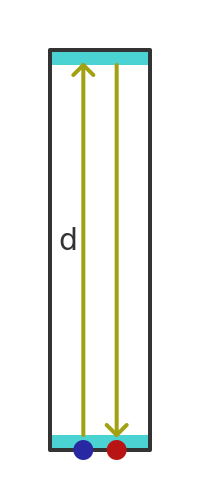
This diagram shows the two paths side by side, for clarity. But in fact, for the light clock to work, the mirrors would have to be very well aligned so that the upward and downward paths are the same. Assuming perfect alignment and perfect mirrors, the light pulse would bounce up and down, again and again, forever.
The distance between the mirrors is d. We know that light travels at a constant velocity c, so the time it takes to travel from the bottom mirror to the top is d/c.
Now let's look at the same clock from the point of view of Alice, who is standing on the train station platform. The train is passing through the station with a constant velocity v:
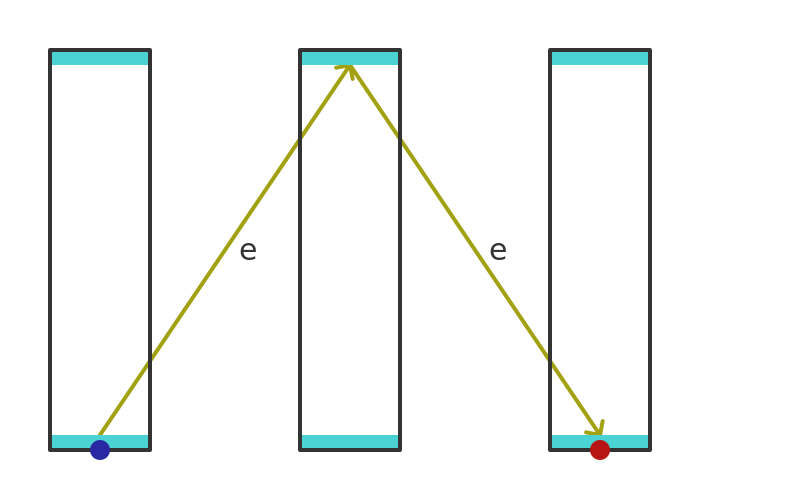
The clock does the same thing for both observers. The light travels from the bottom mirror to the top mirror, then back to the bottom mirror. But for Alice, while the light is travelling from the bottom mirror to the top mirror, the train will have moved along. So from Alice's point of view, the light travels diagonally from the original position of the bottom mirror to the new position of the top mirror.
The light reflects back to the bottom mirror, but by the time it reaches it, the train will have moved on, so the light will again take a diagonal path.
From Alice's point of view, the light travels a distance e to get from the bottom mirror to the top mirror. Since light travels at speed c in all inertial frames of reference, the time taken is e/c
So Alice and Bob will both see the same thing, the light travelling from the bottom to the top and back again. But distance e is clearly greater than distance d, so for Alice it will take longer than for Bob. The only consistent explanation for this is that, from Alice's point of view, time is travelling more slowly for Bob.
And, as mentioned in the earlier article, we now have a wealth of real-world data to prove that this really does happen.
How much slower does time pass?
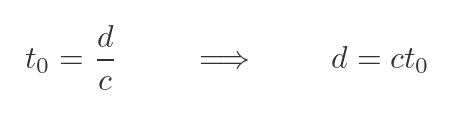
So, for Bob, the light going from the bottom to the top takes d/c. We call this the proper time, t0 because Bob is in the same frame of reference as the clock (they are both on the train, so the clock is at rest for Bob). So:
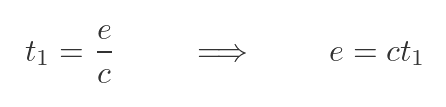
For Alice, the light has to travel a greater distance, e. The time. which we will call t1, is given by:
We can see that these two terms are different, because d and e are different. But how do the two terms relate to each other? Well, if we look again at the situation from Alice's frame of reference, we can draw a right triangle like this:
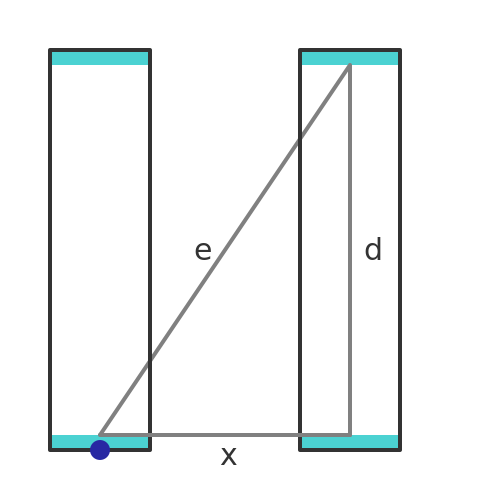
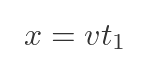
We have just derived expressions for d and e, but what about x? In Alice's frame of reference, the train is travelling at velocity v. The length x is the distance that the train travels in the time it takes for light to travel from the bottom mirror to the top mirror. We have already seen that, for Alice, that time is t1. So the distance x is simply that time multiplied by the speed of the train, v:
So we now know the three lengths of a right-angled triangle. This one of the most unexpected and important equations in physics, but it can be solved using Pythagoras! Here goes:
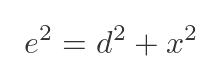
Now we can substitute our known values for d, e and x:
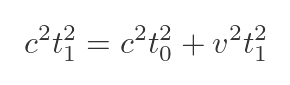
Since we are interested in the relationship between the two times, it will be useful to rearrange the equation so that the t1 terms are on the left and t0 terms are on the right:
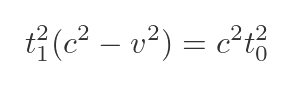
We can divide through by c squared:
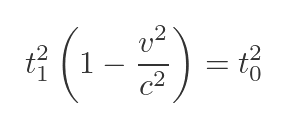
Rearranging:
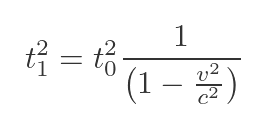
Now we can find the ratio of squares of t1 and t0:
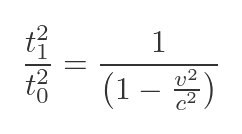
Taking the square root of both sides gives the final result:
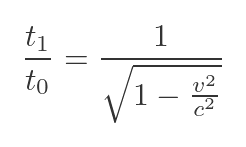
Recall from earlier exactly what this means. From Alice's point of view, time passes more slowly for Bob. Bob's time is dilated from Alice's perspective; the time taken for light to travel a distance d in Bob's frame appears to be longer than Alice would expect. The effect is a constant multiplier that depends only on the train's velocity (and the speed of light, which we know is constant).
We call this multiplier the Lorentz factor, often represented by the Greek letter gamma (γ):
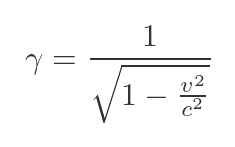
Properties of Lorentz factor
Several interesting features of the Lorentz factor are clear just by looking at it, but they have profound implications for the physical world.
The first is that the velocity v is divided by the speed of light c. Since c is a very large number, then v/c tends to be very small for everyday objects travelling at ordinary speeds. So the Lorentz factor is usually very close to 1.
For example, a train travelling at 100 mph (about 44 m/s) has a Lorentz factor of about 1.00000000000001. Time dilation occurs, but its effect is not noticeable or even detectable in most situations. That is why the concept seems counterintuitive to most people - it is something that we never notice in normal life.
The equation only relies on the velocity squared, which means that time dilation only depends on the magnitude of the velocity, not its direction. It doesn't matter if the train is passing from left to right or from right to left, the time dilation will be the same. Equally, if instead of a train we used an elevator going up or down at the same speed, we would see the same time dilation.
A related observation is that time can be dilated but never contracted. The denominator is the square root of an expression that is always ≤1, which means that the Lorentz factor is always ≥1. So the clock on the moving train always ticks slowly, from the point of view of an observer on the platform.
Now let's consider what happens when v gets bigger. In the graph below, the x-axis represents v/c. So, for example, 0.5 on the x-axis represents the train travelling at half the speed of light. The y-axis shows the Lorentz factor:
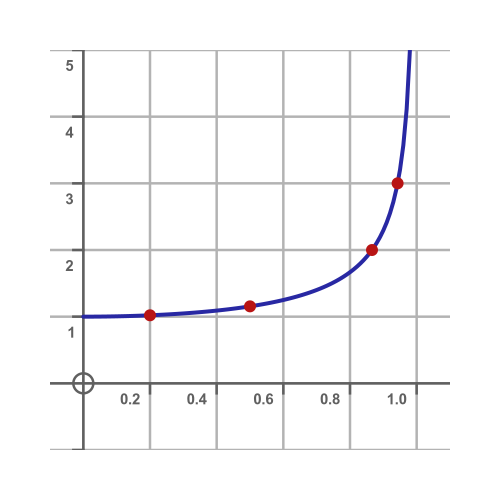
The leftmost red dot (at x = 0.2) represents the train travelling at one-fifth of the speed of light. Even at that immense speed, the Lorentz factor is only just above 1, so there is only a small amount of time dilation happening.
When x is 0.5 (the train travelling at half the speed of light), there is slightly more time dilation.
When x is around 0.866, the Lorentz factor is 2, which means the clock on the train is ticking at half the speed of Alice's clock. When x is around 0.943, the Lorentz factor is 3. So time dilation is quite negligible, even at half the speed of light, but increases rapidly as we approach the speed of light. If the train were to actually reach the speed of light, Alice's clock would be ticking infinitely faster than the clock on the train.
But that isn't possible because of another effect of relativity. We won't cover this here in detail, but the effective mass of an object also increases in line with the Lorentz factor. In other words, as an object approaches the speed of light, its mass tends to infinity. So no object can ever reach the speed of light, because that would require an infinite amount of energy.
But what about light itself? According to quantum theory, light is composed of photons, which are massless particles. Photons travel at the speed of light, but since they have zero rest mass, this does not require them to have infinite energy. But for photons, time dilation is infinite, which means that a photon doesn't experience time at all, even if it spends billions of years traversing the universe.
Related articles
Join the GraphicMaths Newsletter
Want article discussions, announcements, and discounts on GraphicMaths books and products? Join the newsletter:
Popular tags
adder adjacency matrix alu and gate angle answers area argand diagram binary maths cantor cardioid cartesian equation chain rule chord circle cofactor combinations complex modulus complex numbers complex polygon complex power complex root cosh cosine cosine rule countable cpu cube decagon demorgans law derivative determinant diagonal differential equation directrix dodecagon e eigenvalue eigenvector einstein ellipse equilateral triangle erf function euclid euler eulers formula eulers identity exercises exponent exponential exterior angle first principles flip-flop focus gabriels horn galileo gamma function gaussian distribution gradient graph hendecagon heptagon heron hexagon hilbert horizontal hyperbola hyperbolic function hyperbolic functions infinity integration integration by parts integration by substitution interior angle inverse function inverse hyperbolic function inverse matrix irrational irrational number irregular polygon isomorphic graph isosceles trapezium isosceles triangle kite koch curve l system lhopitals rule limit line integral locus logarithm maclaurin series major axis matrix matrix algebra mean minor axis n choose r nand gate net newton raphson method nonagon nor gate normal normal distribution not gate octagon or gate parabola parallelogram parametric equation pentagon perimeter permutation matrix permutations pi pi function polar coordinates polynomial power probability probability distribution product rule proof pythagoras proof pythagorean triple quadrilateral questions quotient rule radians radius rectangle regular polygon rhombus root sech segment set set-reset flip-flop simpsons rule sine sine rule sinh slope sloping lines solving equations solving triangles special relativity speed of light square square root squeeze theorem standard curves standard deviation star polygon statistics straight line graphs surface of revolution symmetry tangent tanh transformation transformations translation trapezium triangle turtle graphics uncountable variance veridical paradox vertical volume volume of revolution xnor gate xor gate