Special relativity time dilation
Categories: relativity
Level:
We saw in an earlier article that two events that occur simultaneously in one frame of reference might not occur simultaneously in another. We saw that two bolts of lightning that strike a train platform at the same time, according to an observer on the platform, would strike the platform at different times, according to an observer on a passing train. And we saw that this isn't just that the strikes appear to have happened at different times; they actually did happen at different times.
This conclusion was the result of a thought experiment by Einstein. He assumed two postulates: that the laws of physics are the same in all inertial frames of reference, and that the speed of light is the same in all inertial frames of reference. His thought experiment told us what would happen if we assume those two postulates are true. And, in fact, the results have been experimentally verified many times in many different ways since Einstein first proposed them.
A further thought experiment proved something equally strange. Time passes at a different rate for someone on a train station platform compared to someone on the moving train! This effect is called time dilation. In this article, we will show how and why it happens.
Light clocks, and thought experiments
To illustrate time dilation, Einstein imagined a special device called a light clock, shown here:
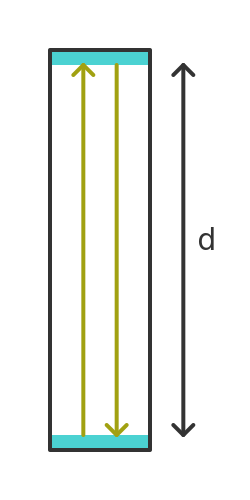
This consisted of two mirrors, facing each other, separated by a distance d. It works as follows:
- A very short "pulse" of light is created just above the lower mirror.
- The light travels up towards the top mirror, and is reflected back downwards.
- The light then travels down towards the bottom mirror, and is reflected back upwards.
- This repeats indefinitely, with the pulse of light bouncing between the two mirrors.
Now, suppose we have a light detector at the bottom mirror. Every time the light returns to the bottom mirror, the detector will trip. This will be like the ticking of a clock. We could even count the ticks and measure the passing of time, just like an ordinary clock.
Since the mirrors are a distance d apart, the light has to travel a distance of 2d to go from the bottom to the top, then back to the bottom. Since we have postulated that light always travels at a constant speed, which we will call c, the time between ticks is 2d/c.
At this point, it is worth thinking about what we mean by a thought experiment. It isn't possible to build a working light clock, for various practical reasons. But that doesn't matter for a thought experiment, because there is nothing in principle to say a light clock cannot exist. So we can ask, if we could build a light clock, how would it behave?
That said, since Einstein first imagined this, we have observed time dilation experimentally many times and in many different ways. There is an example at the end of this article.
Light clock from the point of view of Bob, on the train
In the previous article, we considered the case of a train passing through a station. We imagined two observers, Alice on the station platform, and Bob on the train. Both observers were scientists who understood relativity and had a wealth of scientific instruments to aid their observations. This is illustrated here:
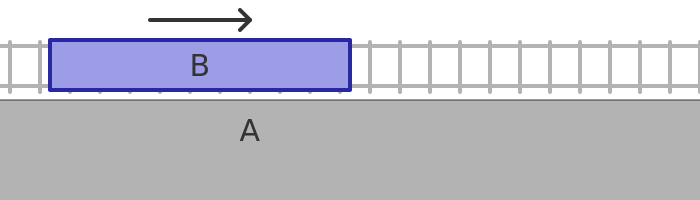
Here, the grey rectangle represents the station, with Alice at point A. The blue rectangle represents the moving train, with Bob at point B
Let's suppose the light clock is on the train. What would Bob see? Well, since Bob is in the same inertial frame of reference as the clock, from his point of view, the clock is at rest, so he would see the light clock ticking exactly as described above, with a time between ticks of 2d/c. Here is the clock at the start of a cycle, when the light pulse is at the bottom mirror:

Here is the clock when the light pulse reaches the top mirror. We will assume that the clock provides a visual indication that the pulse has reached the mirror, so Bob (and Alice) can see it. This is represented by the red circle:
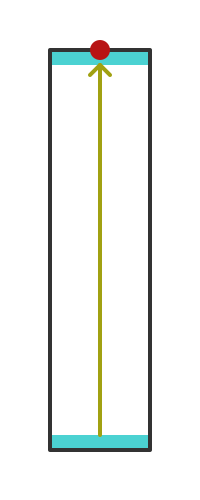
Here is the clock when the light pulse has returned to the bottom mirror. Again, there is a visual indication of this:
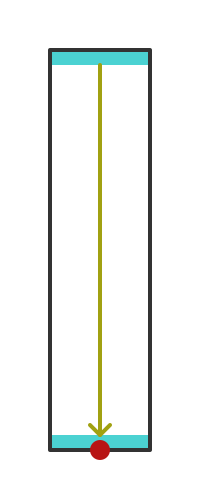
It is important to realise that Bob doesn't need to measure the time it takes. Since we are assuming that light travels at a constant speed c, he can calculate the time. As we saw earlier, the time is 2d/c.
Light clock from the point of view of Alice, on the platform
Now, let's imagine what Alice sees from the platform. Here is the initial state, when the light pulse is at the bottom mirror:

Here is what she sees at the second point, when the light pulse has reached the top mirror:
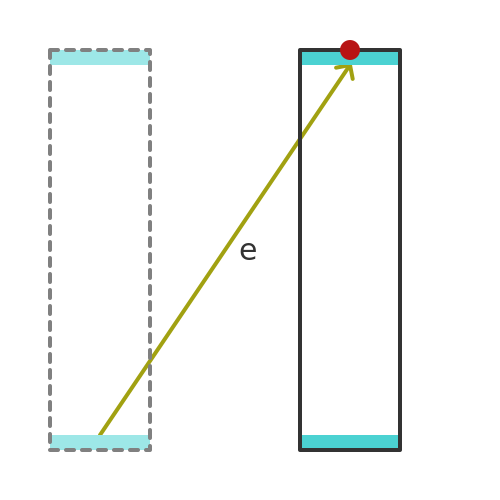
Since the train is moving relative to Alice, she sees the clock in a different position by the time the light reaches the top mirror. She also sees that the light is travelling at an angle relative to the clock, because it is travelling vertically in Bob's frame of reference. Most importantly, this means that, from Alice's point of view, the light travels a distance e from the bottom mirror to the top mirror.
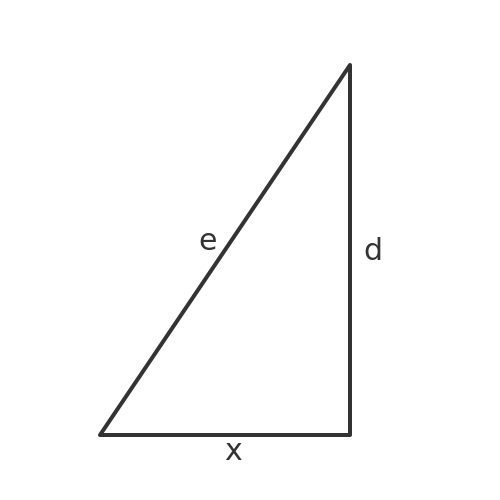
This triangle shows the distance e, the height of the light clock d, and the distance x the train travelled. Since the light clock is vertical and the train is travelling horizontally, this is a right-angled triangle with e as the hypotenuse. So e must be greater than d, because the hypotenuse is always the longest side of a right triangle:
After reflecting off the top mirror, the light is reflected back to the bottom mirror:
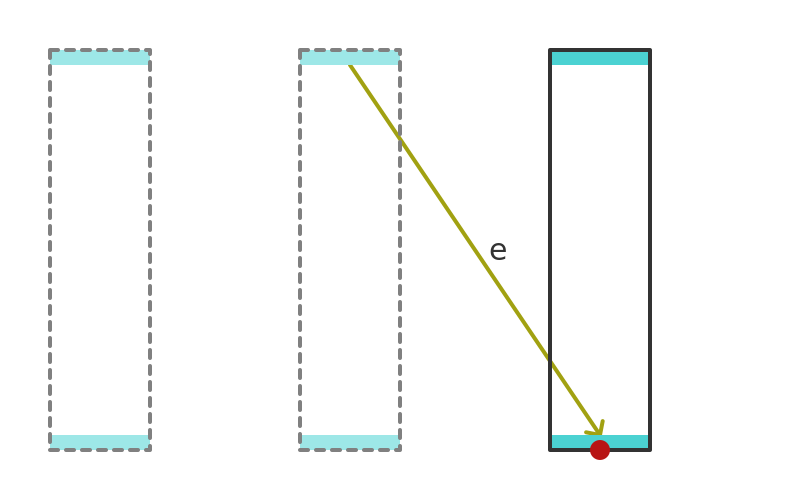
Again, the clock will have moved with the train. Since the train and the light pulse haven't changed speed, the light will travel a distance e.
This means that, in Bob's frame of reference, the time it takes for the light to travel from the bottom to the top and then back to the bottom is 2d/c. But in Alice's frame of reference, that same journey takes a longer time 2e/c.
Measuring time at different positions on the platform
This might seem a little bit like the simultaneity effect, but it is actually slightly different. The previous effect relied on the fact that Alice and Bib were both viewing distant events (two lightning strikes at opposite ends of the train) from different frames of reference.
This time, Alice and Bob don't need to measure anything. Simple logic tells them that they will each experience a different time between the two events.
However, if we wanted to, we could measure the times directly (in principle, not in practice, because this is a thought experiment). Bob is standing right next to the clock so he can time the events directly.
For Alice, it is a little more involved. We could have lots of Alices standing at different points along the platform. So for each event, we would have Bob and one of the Alices very close to the light clock. So they would be timing the same event, local to them.
Time dilation
To summarise what we know so far:
- Alice and Bob can observe the light clock while they are both close to it at the start of the first tick.
- Alice and Bob can observe the light clock again, while they are close to it, at the end of the first tick.
- Between those two events, a time of 2d/c will have passed for Bob. But a longer time of 2e/c will have passed for Alice.
If we observed a second tick, then a total time of 4d/c will have passed for Bob. But a longer time of 4e/c will have passed for Alice. The time difference will increase over time.
The only reasonable explanation is that, from Alice's point of view, time passes more slowly for Bob simply because he is moving.
Of course, Bob doesn't experience time passing more slowly. For him, the light travels a distance of 2d in a time of 2d/c, exactly as he would expect.
And this only happens because light travels at the same speed in every frame of reference.
A light clock on the platform
Now imagine there was a light clock on the platform. In that case, Alice would see the clock ticking every 2d/c seconds. But Bob (or in this case the multiple Bobs on the train) would see the clock on the platform ticking more slowly, every 2e/c seconds.
This might seem like a contradiction. How can time be passing more slowly for Bob and for Alice? Well, of course it isn't, time passes at the normal rate for both of them. But each of them sees the moving clock ticking more slowly.
A real-life example of time dilation
The Frisch–Smith experiment is a famous 1962 experiment that confirms time dilation. It has been repeated many times since then.
Cosmic rays are high-speed particles (mainly protons and helium nuclei) that arrive in the outer atmosphere from space. Those particles collide with atoms in the atmosphere, and, due to their high kinetic energy, smash the atoms into subatomic particles, which are emitted at very high velocities, often approaching the speed of light.
Of particular interest are muons. A muon is a type of lepton, similar in some ways to an electron, which is another type of lepton. But a key thing about muons is that they are unstable, with a mean lifetime of just 2.2 microseconds. They are created in the upper atmosphere by cosmic rays, but most of them decay within a few microseconds. When they decay, they create an electron and a neutrino.
The Frisch–Smith experiment detected muons at the top of a mountain, about 2,000 km above sea level. They had equipment designed to count muons travelling at around 99.5% the speed of light. They then used the same technique to count the number of muons arriving at sea level. Based on the time it would take for a muon to travel 2 km at 99.5% of the speed of light, they expected most of the muons to have decayed before they reached sea level.
But in fact, they found far more muons than expected arriving at ground level. More than 10 times as many. The discrepancy closely matched what you would expect due to relativistic time dilation. Since then, many other experiments have confirmed the same thing.
Time dilation is real. And Einstein discovered it by sitting and thinking.
Related articles
Join the GraphicMaths Newsletter
Want article discussions, announcements, and discounts on GraphicMaths books and products? Join the newsletter:
Popular tags
adder adjacency matrix alu and gate angle answers area argand diagram binary maths cantor cardioid cartesian equation chain rule chord circle cofactor combinations complex modulus complex numbers complex polygon complex power complex root cosh cosine cosine rule countable cpu cube decagon demorgans law derivative determinant diagonal differential equation directrix dodecagon e eigenvalue eigenvector einstein ellipse equilateral triangle erf function euclid euler eulers formula eulers identity exercises exponent exponential exterior angle first principles flip-flop focus gabriels horn galileo gamma function gaussian distribution gradient graph hendecagon heptagon heron hexagon hilbert horizontal hyperbola hyperbolic function hyperbolic functions infinity integration integration by parts integration by substitution interior angle inverse function inverse hyperbolic function inverse matrix irrational irrational number irregular polygon isomorphic graph isosceles trapezium isosceles triangle kite koch curve l system lhopitals rule limit line integral locus logarithm maclaurin series major axis matrix matrix algebra mean minor axis n choose r nand gate net newton raphson method nonagon nor gate normal normal distribution not gate octagon or gate parabola parallelogram parametric equation pentagon perimeter permutation matrix permutations pi pi function polar coordinates polynomial power probability probability distribution product rule proof pythagoras proof pythagorean triple quadrilateral questions quotient rule radians radius rectangle regular polygon rhombus root sech segment set set-reset flip-flop simpsons rule sine sine rule sinh slope sloping lines solving equations solving triangles special relativity speed of light square square root squeeze theorem standard curves standard deviation star polygon statistics straight line graphs surface of revolution symmetry tangent tanh transformation transformations translation trapezium triangle turtle graphics uncountable variance veridical paradox vertical volume volume of revolution xnor gate xor gate