Special relativity length contraction
Categories: relativity
Level:
In a previous article, we looked at Einstein's thought experiment in which a train passes through a station at very high speed. We learned that, from the point of view of someone on the station platform, time passes more slowly for a clock on the train. This is called time dilation.
This time we will look at a second, equally non-intuitive effect. From the point of view of someone on the station platform, the length of objects on the train contracts - but only in the direction the train is travelling.
Einstein's two postulates
Einstein based his ideas on two postulates, which are assumed to be self-evidently true:
- The laws of physics are the same in all inertial frames of reference. Recall that an inertial frame is one where the velocity is not changing (ie the frame is not accelerating, decelerating, or changing direction).
- Light always travels at the same speed, c, in all inertial frames of reference.
The first postulate tells us that the laws of physics are the same for an observer on a train as they are for an observer on a station platform. But there is an additional implication of this postulate: the universe has no preferred direction. Light travelling horizontally behaves the same as light travelling vertically. This follows because what is horizontal in one frame might be vertical in another, and the laws of physics are the same in all frames.
A quick recap on time dilation
Before we start, it is worth quickly revisiting the topic of time dilation.
Einstein imagined a light clock on a train passing through a station. A light clock has a pulse of light that bounces back and forth between two mirrors. The light clock is aligned vertically on the train. Here is what the light clock looks like to an observer on the train:
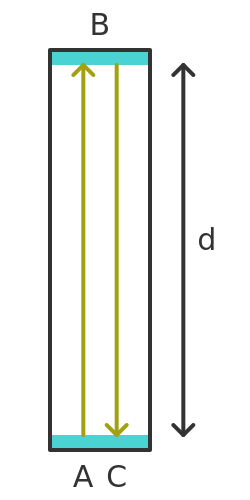
The distance between the two mirrors is d, so the time taken for the light to travel from the bottom mirror (A) to the top mirror (B) and back again (C) is the total distance, 2d, divided by the speed of light, c.
Here is what the light clock looks like to an observer on the platform:
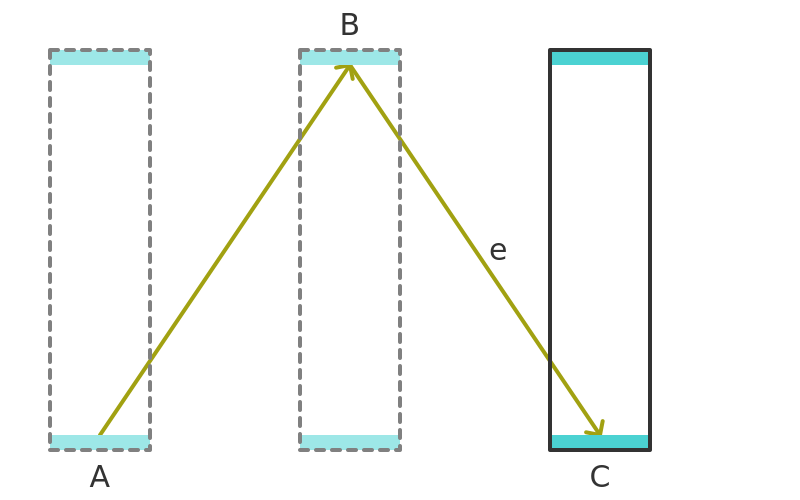
The light sets off from the bottom mirror (A). But by the time the light reaches the top mirror (B), the train has moved along. The light hitting the mirror must have travelled diagonally by a distance e (which is greater than d). A similar thing happens as the light reflects back to the bottom mirror (C).
So here is the strange thing. Observers on the train and the platform would both see the light leaves the bottom mirror (A) simultaneously. They would also see the light returning to the bottom mirror (C) simultaneously. How can this happen if the journey took a different length of time in the two frames? Well, the only explanation is that, from the point of view of the observer on the platform, time passes more slowly in the moving frame. In the time dilation article we saw that the time slows down by a factor of γ:
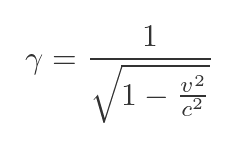
Where v is the velocity of the train. This factor is close to 1 for small values of v, but becomes very large as v approaches c.
Einstein's second thought experiment
Einstein suggested a second thought experiment. What if we had another light clock, identical to the first, but this time we placed it horizontally in the train, in the direction of travel? Here is how this would look to an observer on the train:
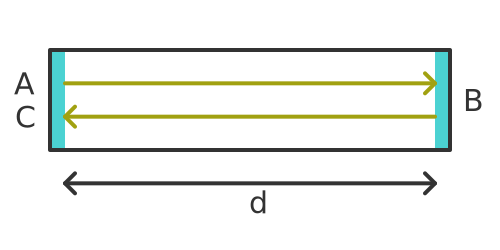
Here, the light pulse starts at A, travels to B, then back to C. The total distance is 2d. The pulse would take the same time as the vertical light clock, as you would expect because they are identical clocks.
But the observer on the platform would see something quite different:
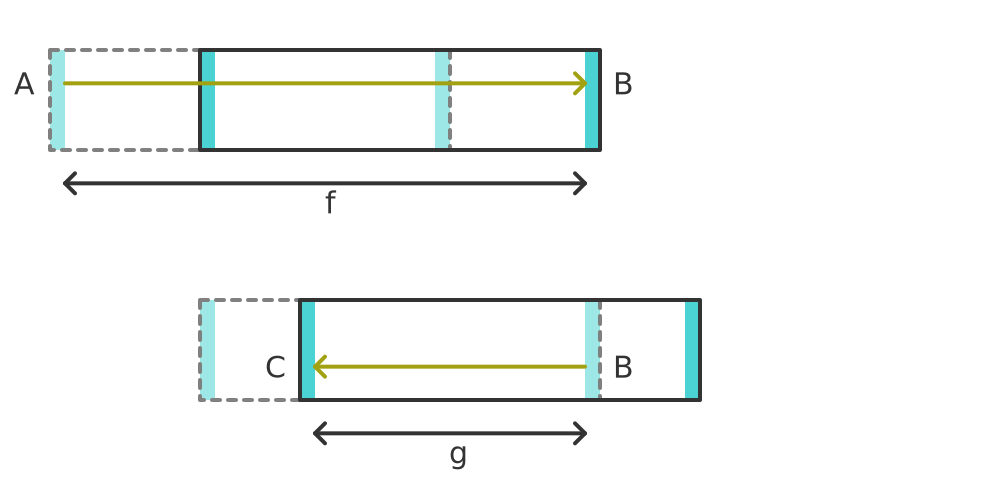
The top part of the diagram shows the light pulse travelling from the first mirror (at A) to the second mirror (at B). As the light pulse sets off from A, the clock is still moving (with the train) so the light pulse has to chase the other mirror. To reach the far mirror, it has to travel a total distance f, which is greater than d.
The light then bounces back off the mirror at B. The lower part of the diagram shows this. The light pulse travels from B to C, but this time the mirror is heading towards the light beam. So this time the light has to travel a distance of g, which is less than d.
Why the second light clock creates a problem for length
Let's imagine we combine the light clock, like this:
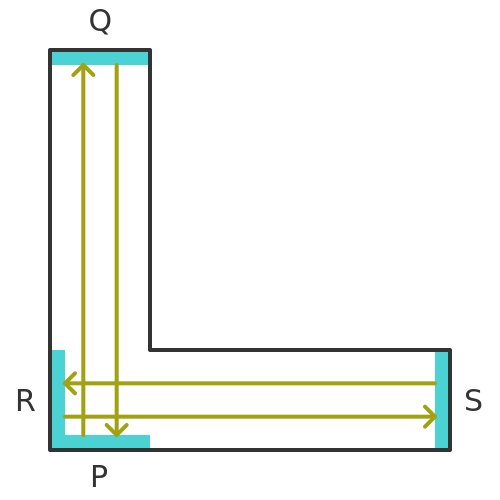
We create a pulse of light in the bottom left corner. From the point of view of an observer on the train, some of the light travels vertically, from P to Q, then back to P. Some of the light travels horizontally, from R to S, then back to R. Crucially, both pulses arrive back at P/R at exactly the same time. That is because they both travelled the same distance 2d at the constant speed of light.
From the point of view of an observer on the platform, we can make one very important observation. The two light pulses start simultaneously at P/R, and they also arrive back at P/R simultaneously. That is because if two events happen at the same time and place in one frame, they must happen at the same time and place in every other frame.
Now the light from P to Q and back travels a distance of 2e, which is greater than 2d. We account for this by saying that time passes at a different rate on the train, according to an observer on the platform.
But now we also know that light from R to S and back travels a distance of f + g, and this takes exactly the same time as the light travelling from P to Q and back. Since both pulses of light travel at speed c in all frames, the two times can only be the same if f + g is equal to 2e in all frames. But if we do the calculations, those two distances aren't equal. In fact, when v is greater than zero (ie when the train is moving), f + g is always bigger than 2e.
A solution - length contraction
There is only one solution to this dilemma. From the point of view of an observer on the platform, the distance RS must be shorter than the distance PQ. It must be shorter by the exact amount required such that the two light pulses arrive back at the start at exactly the same time.
So, in the same way that the observer on the platform sees time on the train pass more slowly (time dilation), they also see the length of objects on the train being shorter (length contraction), but only in the direction of travel of the train.
Both effects occur together, and both effects are required to properly explain the behaviour of the two light clocks on the moving train.
Einstein calculated the size of this effect. It is quite a lengthy calculation, so we won't show it here. We will derive the same result in a much simpler way using Lorentz transforms in a future article. But he found that:
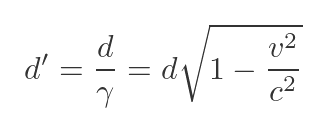
Here, d is the length of the horizontal light clock as seen by an observer on the train, d' is the length as seen by an observer on the platform, and γ is the Lorentz factor for the velocity of the train v. Since γ is always >= 1, d' is always <= d. So length can only ever be contracted, never expanded.
This demonstrates quite an elegant symmetry. Time is dilated by a factor of γ, length is contracted by a factor of 1/γ.
What length contraction is, and what it is not
There are some common misconceptions that people often have when they first encounter length contraction:
- It is not an optical illusion caused by the time it takes for light to travel from different places on the train. It is a real, physical effect.
- It can be measured. For example, if there were several synchronised clocks on the train platform, we could measure exactly where the two ends of the light clock were at the same instant in time, and they would indeed be closer together than they are when measured on the train.
- The effect is symmetric between frames. If there were a light clock on the platform, then an observer on the train would see it as contracted.
- The light clock isn't physically "squished" in any way. In its rest frame (the train), the light clock isn't moving, so it has its normal length.
- The effect is only easily visible at very high speed.
On the last point, if a train were travelling at 500 m/s (over a thousand miles per hour), its Lorentz factor would be about 1.00000000000139. This means that, if the light clock were 1m long, its length would contract by 1.39 picometres, which is about 1/20th of the diameter of a hydrogen atom.
Real world example - muons
In the earlier article on time dilation, we looked at the real world example of muons in the Earth's atmosphere. Muons are subatomic particles in the same class as electrons. They are leptons ("light" particles, they weigh much less than protons and neutrons). But unlike electrons, muons are unstable and have a half-life of about 2.2 microseconds.
Muons are created when cosmic rays smash into atoms in the upper atmosphere. The muons are created with very high velocities (around 99.5% of the speed of light), and some of them shoot down towards the Earth's surface. Given their short lifetime, we would expect almost all muons to decay before reaching the ground. From the Earth's point of view, the journey through the atmosphere takes far longer than a muon's half-life. But an observer on Earth also knows the muon is travelling extremely fast, so it experiences time dilation: its internal 'clock' runs slow relative to Earth, giving it enough extra lifetime (as measured on Earth) to survive the trip.
But an observer on Earth also knows that, since the muon is travelling so fast, it will experience time dilation. So the observer on Earth can calculate that the muon experiences only a few microseconds of time as it descends through the atmosphere, so many muons will survive the journey.
The LHS of the diagram below shows the situation from the point of view of an observer on the Earth. The dark blue circle is the Earth, the light blue is the atmosphere, and the red dot is a muon. The diagram is not drawn to scale. In reality, the atmosphere is a very thin layer around the Earth.
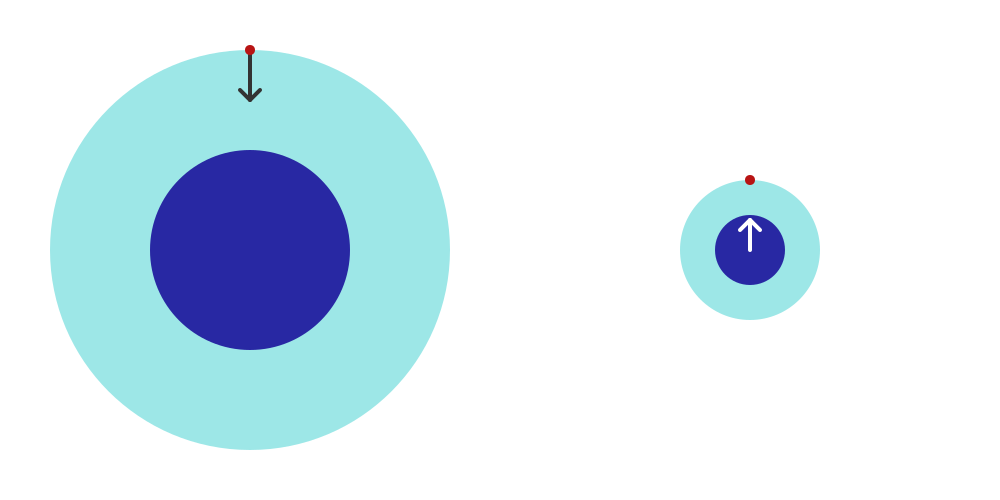
But what does the muon experience? Well, due to time dilation, we know that it takes muons much less time to reach Earth. But how can they travel all that distance in such a short time?
The RHS of the diagram shows why. In the muons' frame of reference, the muon itself is stationary, but the Earth is moving towards it at 99.5% of the speed of light. This means that the Earth and its atmosphere are contracted in the direction of travel. So the muon only needs to travel a short distance to reach the surface.
There is an interesting symmetry here. In Earth's frame of reference, time is ticking more slowly for the muon, so it can pass through Earth's atmosphere because it takes longer to decay. In the muon's frame of reference, the Earth and its atmosphere are contracted by the same factor, so the muon can pass through the Earth's atmosphere because it is a shorter distance.
Conclusion
Length contraction, like time dilation, is not some trick or mathematical hack. It is a real effect that can be measured. It has to happen because the speed of light is the same in every inertial frame.
The orthogonal clock thought experiment illustrates the effect cleanly and simply. But length contraction has also been seen in many real-life experiments.
Related articles
Join the GraphicMaths Newsletter
Want article discussions, announcements, and discounts on GraphicMaths books and products? Join the newsletter:
Popular tags
adder adjacency matrix alu and gate angle answers area argand diagram binary maths cantor cardioid cartesian equation chain rule chord circle cofactor combinations complex modulus complex numbers complex polygon complex power complex root cosh cosine cosine rule countable cpu cube decagon demorgans law derivative determinant diagonal differential equation directrix dodecagon e eigenvalue eigenvector einstein ellipse equilateral triangle erf function euclid euler eulers formula eulers identity exercises exponent exponential exterior angle first principles flip-flop focus gabriels horn galileo gamma function gaussian distribution gradient graph hendecagon heptagon heron hexagon hilbert horizontal hyperbola hyperbolic function hyperbolic functions infinity integration integration by parts integration by substitution interior angle inverse function inverse hyperbolic function inverse matrix irrational irrational number irregular polygon isomorphic graph isosceles trapezium isosceles triangle kite koch curve l system lhopitals rule limit line integral locus logarithm maclaurin series major axis matrix matrix algebra mean minor axis n choose r nand gate net newton raphson method nonagon nor gate normal normal distribution not gate octagon or gate parabola parallelogram parametric equation pentagon perimeter permutation matrix permutations pi pi function polar coordinates polynomial power probability probability distribution product rule proof pythagoras proof pythagorean triple quadrilateral questions quotient rule radians radius rectangle regular polygon rhombus root sech segment set set-reset flip-flop simpsons rule sine sine rule sinh slope sloping lines solving equations solving triangles special relativity speed of light square square root squeeze theorem standard curves standard deviation star polygon statistics straight line graphs surface of revolution symmetry tangent tanh transformation transformations translation trapezium triangle turtle graphics uncountable variance veridical paradox vertical volume volume of revolution xnor gate xor gate