Special relativity simultaneity
Categories: relativity
Level:
People have tried to measure the speed of light for centuries, dating back to Galileo or earlier. In the late 19th century, a few theoretical and practical results improved the accuracy of earlier experiments and revealed a strange fact about light.
Maxwell, Michelson and Morley
Maxwell's equations describe how electromagnetic fields behave. They show that waves can travel through the field. The theoretical speed of these waves could be calculated, and it was very close to the speed of light. Maxwell guessed that light might be an electromagnetic wave.
What was even more interesting was that, according to Maxwell's equations, the speed of light appeared to be constant regardless of the speed of the observer.
Michelson and Morley later did an experiment to check this. They measured light's speed in two perpendicular directions. The Earth moves around the Sun at over 100,000 km/h. You might expect a small difference in measured speed due to Earth’s motion in one direction. No difference was found. This suggested that the speed of light does not depend on the observer's motion.
Einstein's thought experiment
This strange result was largely ignored until the early 20th century, when Einstein decided to take a closer look. But he didn't perform any experiment.
He simply took two postulates:
- The laws of physics are the same in all inertial frames. An inertial frame does not accelerate or change direction.
- The speed of light in a vacuum is constant for all observers, regardless of their motion or the source's motion.
He then asked the question, given that these things are both true, what would you expect to happen?
Einstein's train
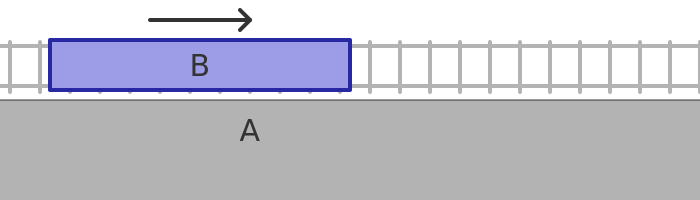
Einstein imagined an observer, Alice, standing on a railway station. He pictured a train carriage passing by at high speed. A second observer, Bob, would stand at the exact centre of the train. The diagram below shows a top view, with the train in blue, Alice (A) on the platform, and Bob (B) on the train:
Now let's imagine that, at the precise moment that Alice and Bob are exactly opposite each other, two bolts of lightning strike the platform at opposite ends of the train. These are shown below by the yellow and orange dots (we use the colours to distinguish the two strikes on the diagram, not to suggest that the lightning itself is that colour):
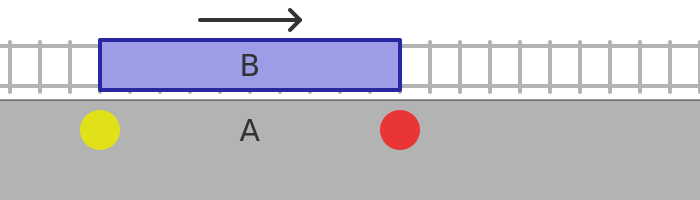
Bob is standing in the middle of the train. Alice and Bob are opposite each other. So, the two lightning strikes are the same distance from Alice and Bob.
Now, Alice and Bob are scientists who understand the speed of light and Einstein's two postulates. They have cameras and other equipment on the platform to observe the events and work out the sequence of events.
The platform, from Alice's viewpoint
The diagram shows what happens on the platform, from Alice's point of view:
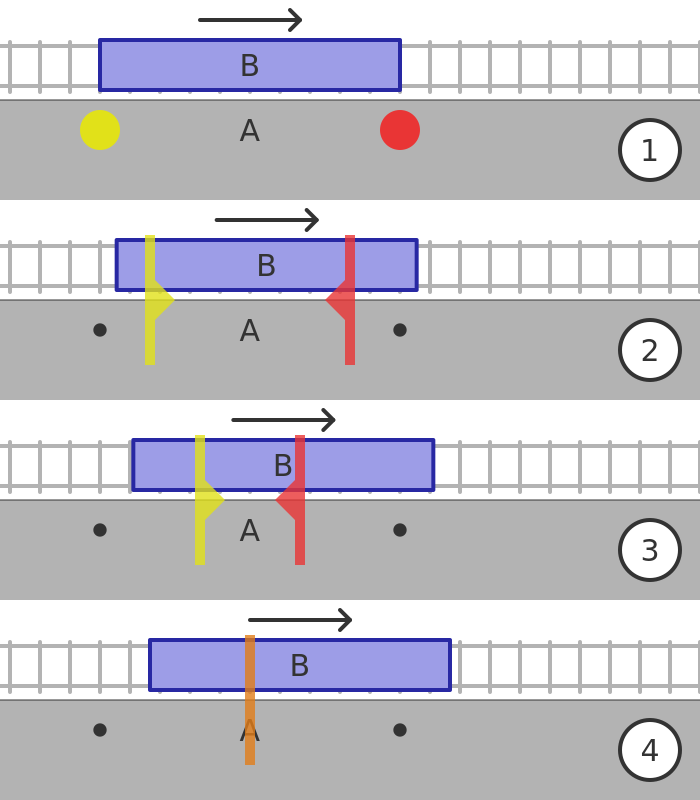
Image 1 shows the lightning strikes. Alice won't see the lightning instantly, because it takes a finite amount of time for the light to travel to her.
Images 2 and 3 show the light travelling towards her.
In image 4, light from both strikes reaches Alice simultaneously.
What does Alice know?
- She knows that the lightning strikes were both the same distance from her, she has photographs of where the lightning landed.
- She knows that the light from both strikes arrived at her location at the same time. She has two sensors that detect the time of arrival of light, using the same clock.
However, she DOESN'T know for certain whether the two strikes happened at exactly the same time. The strikes were measured at two different places, and there is some suggestion that distance and movement might affect the timing. So, just to be safe, she will only trust that two times are the same if they are measured at the same place using the same clock.
But here is what she can deduce. Both light flashes arrived at her location at the same time, and both lightning strikes happened the same distance away from her. So, since light always travels at the same speed, the two lightning strikes must have happened at the same time.
The train, from Alice's viewpoint
Alice can also figure out what Bob saw on the train.
Look again at step 4 above, the point when the two light flashes arrive at Alice. We can see that Bob will already have moved some distance to the right. Alice even has a photo to prove it.
This means the red flash will have already passed Bob, but the yellow flash won't have reached him yet. Bob will have seen one flash, but not yet seen the other. To him, the flashes will appear to have happened at different times.
But there is nothing strange about that. Bob is travelling towards the source of the red flash and away from the source of the yellow flash. Since light has a finite speed, he will, of course, see the red flash first. That is exactly what you would expect.
The train, from Bob's point of view
This is where things get a little strange. Here is what Bob sees:
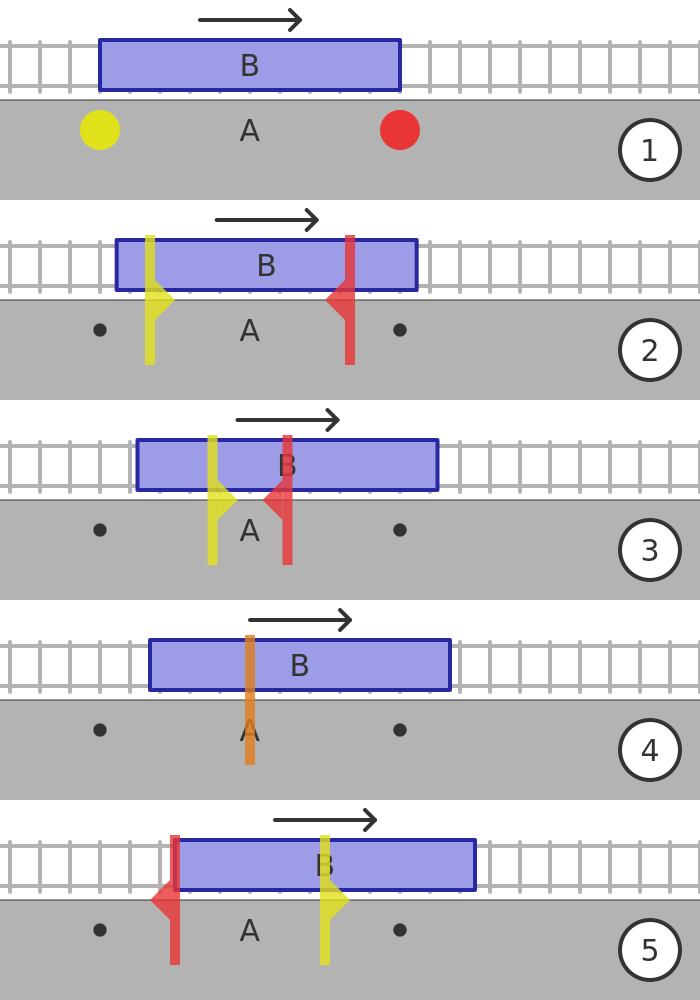
Notice that the timepoints shown here are not exactly the same as those in the previous diagram.
Images 1 and 2 show the lightning strikes and the flashes moving along the train towards Bob.
Image 3 shows the red flash reaching Bob.
Image 4 shows both flashes reaching Alice simultaneously.
Image 5 shows the yellow flash reaching Bob.
What does Bob know?
- He knows that the lightning strikes were both the same distance from him, he has photographs of where the lightning landed. The lightning landed at either end of the train.
- He knows that the light from both strikes arrived at his location at the different times. He has two sensors that detect the time of arrival of light, using the same clock.
Here is what he can deduce:
- Both light flashes arrived at his location at different times.
- Both lightning strikes happened the same distance away from him (we already know that, above).
- So, since light always travels at the same speed, the two lightning strikes could not possibly have happened at the same time.
So, by pure logic, Einstein figured out that two events that are simultaneous in one inertial frame might not be simultaneous in another.
A common misconception
You might still be unconvinced. You might be thinking, wouldn't the same thing happen if we use, say, a tennis ball instead of light?
Yes, it would. Almost.
Let's revisit the previous diagram, but using tennis balls rather than light. In image 1, as the train passes, two people on the platform throw a tennis ball towards Alice from opposite directions. In image 2, those balls travel towards Alice.
In image 3, the red ball passes Bob, in image 4, both balls pass Alice, and in image 5, the yellow ball passes Bob. Exactly like the light.
If Bob wasn't a scientist, and he had been told that both balls had been launched from the same distance and at the same speed, he might come to the conclusion that the red ball must have been launched before the yellow ball.
But Bob is a scientist, and he has a radar speed sensor, so he knows that the speed of the red ball (relative to the train) is faster than the speed of the yellow ball (relative to the train). The balls were thrown at the same speed relative to the platform, but the speeds relative to the train are different because the train is moving too.
He can do the calculation and confirm that the balls were indeed thrown at the same time.
The essential difference is that light always travels at the same speed for observers in any inertial frame. That makes no sense in the context of ordinary objects like balls, but it is how light behaves, so it leads to counterintuitive results.
To the person on the train, it doesn't just look like the lightning strikes happened at different times. They actually did happen at different times.
Related articles
Join the GraphicMaths Newsletter
Want article discussions, announcements, and discounts on GraphicMaths books and products? Join the newsletter:
Popular tags
adder adjacency matrix alu and gate angle answers area argand diagram binary maths cantor cardioid cartesian equation chain rule chord circle cofactor combinations complex modulus complex numbers complex polygon complex power complex root cosh cosine cosine rule countable cpu cube decagon demorgans law derivative determinant diagonal differential equation directrix dodecagon e eigenvalue eigenvector einstein ellipse equilateral triangle erf function euclid euler eulers formula eulers identity exercises exponent exponential exterior angle first principles flip-flop focus gabriels horn galileo gamma function gaussian distribution gradient graph hendecagon heptagon heron hexagon hilbert horizontal hyperbola hyperbolic function hyperbolic functions infinity integration integration by parts integration by substitution interior angle inverse function inverse hyperbolic function inverse matrix irrational irrational number irregular polygon isomorphic graph isosceles trapezium isosceles triangle kite koch curve l system lhopitals rule limit line integral locus logarithm maclaurin series major axis matrix matrix algebra mean minor axis n choose r nand gate net newton raphson method nonagon nor gate normal normal distribution not gate octagon or gate parabola parallelogram parametric equation pentagon perimeter permutation matrix permutations pi pi function polar coordinates polynomial power probability probability distribution product rule proof pythagoras proof pythagorean triple quadrilateral questions quotient rule radians radius rectangle regular polygon rhombus root sech segment set set-reset flip-flop simpsons rule sine sine rule sinh slope sloping lines solving equations solving triangles special relativity speed of light square square root squeeze theorem standard curves standard deviation star polygon statistics straight line graphs surface of revolution symmetry tangent tanh transformation transformations translation trapezium triangle turtle graphics uncountable variance veridical paradox vertical volume volume of revolution xnor gate xor gate