Elevator paradox
Categories: recreational maths paradox
Level:
Two physicists, Marvin Stern and George Gamow, worked in the same building, a large multi-storey building, with a single elevator serving all the floors.
Both men had noticed a slightly odd phenomenon. Whenever they wanted to use the elevator, it seemed that it was usually going in the wrong direction. If they wanted to go down, when the elevator arrived, it was usually going up. When they wanted to go up, the elevator was usually going down. They had both noticed this effect independently. But it was only when it came up in conversation that they realised it might be a real effect worthy of investigation. This phenomenon became known as the elevator paradox, which they highlighted in 1958.
Confirmation bias?
Confirmation bias is an unconscious human tendency to selectively notice and remember anything that confirms your existing beliefs, whilst downplaying or ignoring anything that contradicts them.
It is easy to see how that might arise in the elevator case. If the elevator arrives and happens to be going up when you want to go down, that is quite annoying. You have to stand and wait until it goes all the way to the top and comes back down again. That sticks in your mind.
If you are late for a meeting, that extra delay is going to be really annoying, and looms even larger in your memory.
But if the elevator arrives and it happens to be going down, you get on the elevator and think no more about it. It would be very easy, after months or years, to form the opinion that the elevator is almost always going in the wrong direction.
So the physicists decided to eliminate confirmation bias. Each time they used the lift, they recorded:
- Whether the lift was going up or down when it arrived.
- Whether they were intending to go up or down.
After weeks of gathering these statistics, they discovered that the effect was real. The elevator was statistically more likely to be going in the wrong direction when it arrived. The effect was significant enough to be undeniably true.
The apparent paradox
This effect seems very puzzling and paradoxical, for several reasons.
The first is that if the lift arrives at, say, floor 3 and is going up, then the next time it arrives at floor 3 it must be going down, then up, then down, and so on. The lift can't arrive at floor 3 going up, and then arrive at floor 3 going up again.
We can also say that when the lift arrives at floor 3 for the nth time in the day (where n is a random number), it is equally likely to be going up or down.
We assume here that the lift always travels from the lowest floor to the top floor, then back to the lowest floor, in a continuous cycle. We will also ignore the case of anyone waiting for the lift at the bottom or top floor, because the lift changes direction there so it will always be travelling in the right direction for anyone waiting there. These are special cases.
But there is another random factor as well. For the lift to be going in the "wrong" direction depends on which direction you want to go. For example, suppose you arrive at the floor 3 lift and the next lift is going down. If you are intending to go to a meeting on floor 5, that would be the wrong direction for you. But if you are intending to get a snack from the vending machine on floor 2, it would be the right direction for you.
So how can the direction be wrong more often than it is right?
A simple building
This diagram represents a simple building:
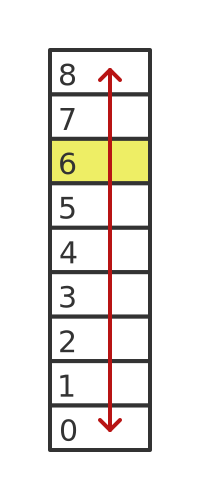
The building has 9 floors, with floor 0 being the ground floor, and floor 8 the top floor. There is a single elevator that travels from floor 0 to floor 8. It is a simple system that goes all the way to the top, then all the way to the bottom, stopping at every floor it is requested to.
An observer is positioned on floor 6, marked as yellow. If the observer simply watches the elevator, they will see it goes up and down repeatedly. It will alternate, of course, if it is going up one time, it must be going down the next time, and vice versa. If the observer watches for a while, the number of times the elevator goes up must equal the number of times the elevator comes down, plus or minus one.
The description above is stating the obvious, of course. The point is, the elevator is no more likely to be going up than down at any point in time.
So what is going on?
In reality, of course, people don't usually stand around watching the elevator going up and down. They use the elevator when they need to. In other words, they will get on the elevator whenever it arrives.
Will the elevator be going up or down? It depends on where the elevator happened to be when the observer arrived. This is shown below:
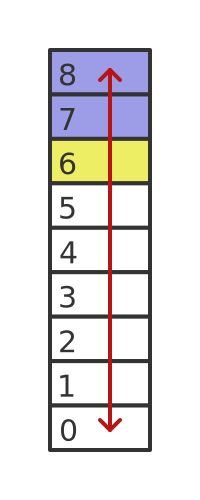
When the observer arrives at the elevator, assuming again that they are on floor 6, we can see that:
- If the elevator happens to be in the blue region (floors 7, 8), then it will be travelling downwards when it arrives at floor 6.
- If the elevator happens to be in the white region (floors 0 to 5), then it will be travelling upwards when it arrives at floor 6.
We will ignore the case where the elevator is already on floor 6. In that case, the direction of travel depends on whether the elevator has come from the blue ot white regions.
Now here is the important thing. When the observer turns up at some random time, the elevator is more likely to be in the white region, because there are more floors in the white region than there are in the blue region. In fact, if the lift spends the same average time on each floor, it will spend three-quarters of its time in the white region.
This means the lift is three times as likely to be going up as going down.
There is a second thing to consider. Since floor 6 is higher up in the building, it seems reasonable to expect that most people on floor 6 will want to go down, because there are more floors below floor 6 than above it.
Combining those two assumptions, the lift is going in the wrong direction most of the time.
Other floors
Now let's imagine our observer is on floor 2:
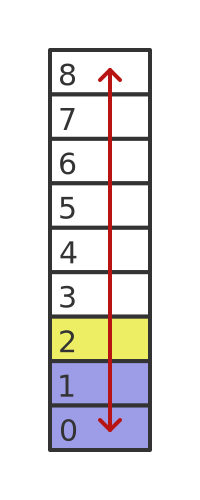
This time, the situation is reversed. There are more floors above floor 2 than there are below it. So, in this case, someone arriving at the elevator would be more likely to find it going down. But since they are on a low floor, they are probably more likely to be going up. So, once again, they would find that the elevator is going in the wrong direction, more often than not.
What if the observer is on floor 4? It looks like this:
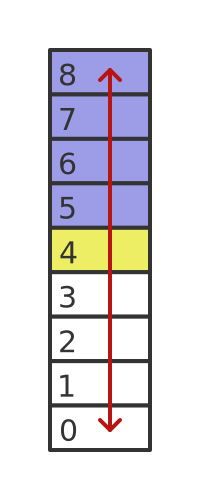
This time, the floor is halfway up the building, with 4 floors above and 4 below. So the next elevator could come from either direction with roughly equal probability. And since they are in the middle of the building, they might want to go up or down, with more or less equal probability.
They might, therefore, find that the elevator is going in the right direction for them approximately half the time.
But, of course, they will then be on a higher or lower floor, so their next journey is more likely to have the elevator going in the wrong direction. So they would still see the effect.
Modern elevators
Most modern elevators are computer-controlled, so they might use algorithms to reduce this effect. That is particularly true if there are multiple elevators in the building. The algorithm might move elevators around when they are not in use to meet anticipated demand. It might take into account the busier times of day. It might even have dedicated elevators that serve only the first few floors.
Perhaps this is the legacy of Stern and Gamow!
Related articles
- Monty Hall problem
- Pigeonhole principle
- Drunk man and keys problem
- Simpson's paradox
- Two envelope paradox
- Raven paradox
- Painter's paradox
- Potato paradox
- Sleeping Beauty problem
- Russell's paradox
- Newcomb's paradox
- Surprise exam paradox
- Coin rotation paradox
- Galileo's paradox
- Hilbert's Hotel: Why a Fully Booked Infinite Hotel Never Turns You Away
- Infinite mermaid paradox
Join the GraphicMaths Newsletter
Want article discussions, announcements, and discounts on GraphicMaths books and products? Join the newsletter:
Popular tags
adder adjacency matrix alu and gate angle answers area argand diagram binary maths cantor cardioid cartesian equation chain rule chord circle cofactor combinations complex modulus complex numbers complex polygon complex power complex root cosh cosine cosine rule countable cpu cube decagon demorgans law derivative determinant diagonal differential equation directrix dodecagon e eigenvalue eigenvector einstein ellipse equilateral triangle erf function euclid euler eulers formula eulers identity exercises exponent exponential exterior angle first principles flip-flop focus gabriels horn galileo gamma function gaussian distribution gradient graph hendecagon heptagon heron hexagon hilbert horizontal hyperbola hyperbolic function hyperbolic functions infinity integration integration by parts integration by substitution interior angle inverse function inverse hyperbolic function inverse matrix irrational irrational number irregular polygon isomorphic graph isosceles trapezium isosceles triangle kite koch curve l system lhopitals rule limit line integral locus logarithm maclaurin series major axis matrix matrix algebra mean minor axis n choose r nand gate net newton raphson method nonagon nor gate normal normal distribution not gate octagon or gate parabola parallelogram parametric equation pentagon perimeter permutation matrix permutations pi pi function polar coordinates polynomial power probability probability distribution product rule proof pythagoras proof pythagorean triple quadrilateral questions quotient rule radians radius rectangle regular polygon rhombus root sech segment set set-reset flip-flop simpsons rule sine sine rule sinh slope sloping lines solving equations solving triangles special relativity speed of light square square root squeeze theorem standard curves standard deviation star polygon statistics straight line graphs surface of revolution symmetry tangent tanh transformation transformations translation trapezium triangle turtle graphics uncountable variance veridical paradox vertical volume volume of revolution xnor gate xor gate