Circle inscribed in a 3-4-5 triangle puzzle
Categories: gcse geometry circle geometry circle theorems trigonometry pythagoras
Level:
Here is an interesting little puzzle that can be solved using basic geometry. The red circle touches each of the triangle's three sides. Prove that the area of the circle is exactly Pi!
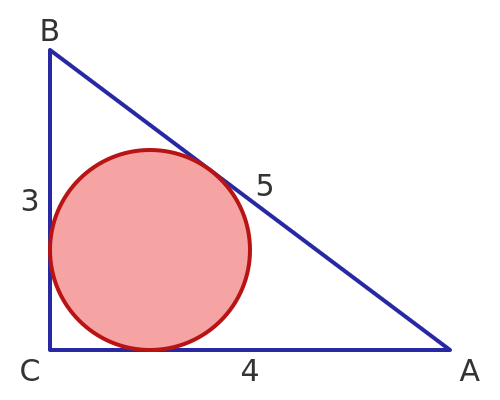
A circle that touches all three sides of a triangle from the inside is called an inscribed circle, or incircle. Its centre is called the incentre.
It might seem very strange that the area is equal to Pi, so you might expect proving it to be very difficult. But it can be done quite easily with basic geometry that you probably already know.
Step 1 - the triangle is a right-angle triangle
You probably recognise the numbers 3, 4 and 5. It is a famous Pythagorean triple.
We know that the sides of a right-angled triangle obey Pythagoras' theorem:
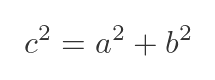
When a, b and c are equal to 3, 4 and 5, they obey Pythagoras' theorem:
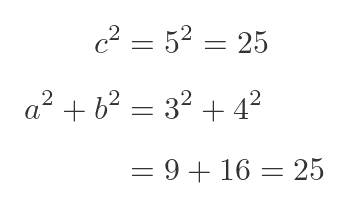
This means that our triangle is right-angled:
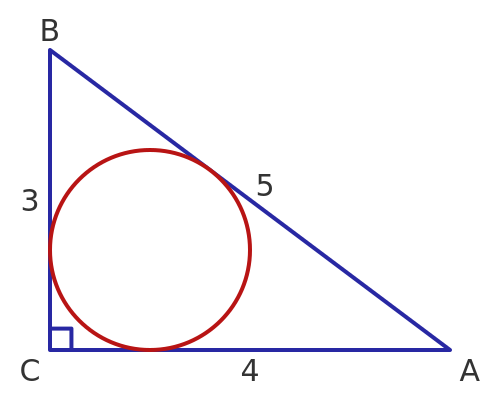
Step 2 - finding the radius of the inscribed circle
Since we are interested in the area of the circle, it might be useful to find its radius, which we will call r. To help with this, we can draw three radii from the centre of the circle to the points where the circle touches the triangle, at points E, F and G. This is shown here:
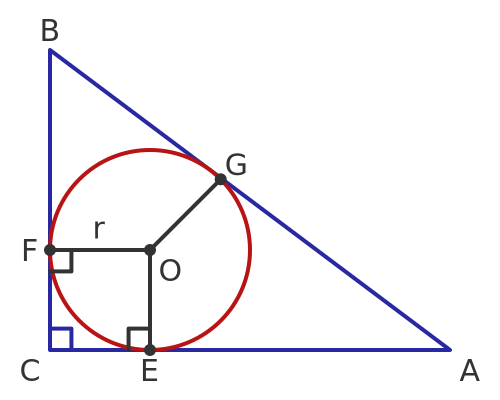
Notice that the base of the triangle, AC, is a tangent to the circle. Also, the radius OE meets the tangent at E. We know that the angle between a tangent and a radius is a right angle. So OEC is a right-angle.
Also, the side BC is a tangent that meets the radius OF, so the angle OFC is also a right angle for the same reason.
We know from earlier that FCE is a right angle, because it is a right-angled triangle.
Looking at the quadrilateral FCEO, we can see that three of the corners are right angles. Since the internal angles of a quadrilateral add up to 360 degrees, it follows that the final angle, FOE, must also be a right angle.
Also, EO and FO are both radii of the circle, so they must have equal length.
This means that FCEO must be a square, of side r. This means that CF and CE are both equal to r
Finding the side lengths in terms of the radius
In this next step, we will make use of another rule of circle geometry, that Two tangents from a point have equal length.
Looking at the diagram, the lines BF and BG are both tangents from the point B, so they are both the same length:
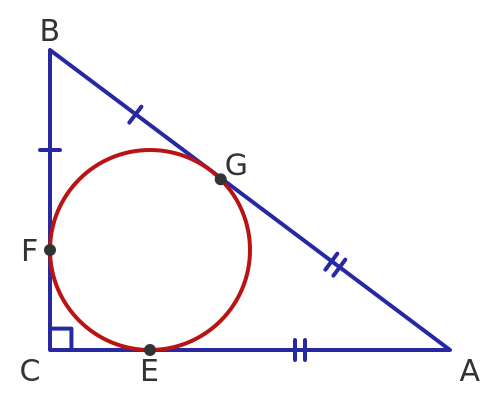
Similarly, the lines AE and AG are both tangents from the point A, so they are both the same length.
We know that BC has length 3, because it is a 345 triangle. We know that FC has length r, because the square FCEO has side r. So we can find the length BF:

We can find the length AE in a similar way, because AC has length 4 and EC has length r:

We can also find the hypotenuse, BA, in terms of BG and AG, it is just the sum of those two lengths:
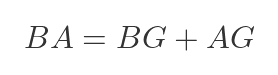
As we have just seen, by the tangent rule, BG equals BF, and AG equals AE, so we can substitute those values:
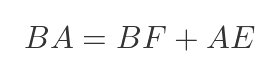
But we know BF and AE in terms of r, so now we can find BA in terms of r:

Of course, BA is the hypotenuse of the triangle, so it is equal to 5, so we can solve for r:

So the radius of the circle is 1.
Finding the area of the circle
Given the radius of the circle, we can find its area from the circle area formula:

Since r = 1, the area is π × 1 × 1 = π. So the area of the inscribed circle is exactly π square units, which is what we set out to prove!
Related articles
- Parts of a circle
- Perpendicular bisector of chord theorem
- Angle at the centre of a circle is twice the angle at the circumference
- Angle in a semicircle is 90°
- Angles in the same segment of a circle are equal
- Opposite angles in a cyclic quadrilateral add up to 180°
- Tangent and radius of a circle meet at 90°
- Two tangents from a point have equal length
- Alternate segment theorem
- Two radii form an isosceles triangle
Join the GraphicMaths Newsletter
Sign up using this form to receive an email when new content is added to the graphpicmaths or pythoninformer websites:
Popular tags
adder adjacency matrix alu and gate angle answers area argand diagram binary maths cardioid cartesian equation chain rule chord circle cofactor combinations complex modulus complex numbers complex polygon complex power complex root cosh cosine cosine rule countable cpu cube decagon demorgans law derivative determinant diagonal differential equation directrix dodecagon e eigenvalue eigenvector einstein ellipse equilateral triangle erf function euclid euler eulers formula eulers identity exercises exponent exponential exterior angle first principles flip-flop focus gabriels horn galileo gamma function gaussian distribution gradient graph hendecagon heptagon heron hexagon hilbert horizontal hyperbola hyperbolic function hyperbolic functions infinity integration integration by parts integration by substitution interior angle inverse function inverse hyperbolic function inverse matrix irrational irrational number irregular polygon isomorphic graph isosceles trapezium isosceles triangle kite koch curve l system lhopitals rule limit line integral locus logarithm maclaurin series major axis matrix matrix algebra mean minor axis n choose r nand gate net newton raphson method nonagon nor gate normal normal distribution not gate octagon or gate parabola parallelogram parametric equation pentagon perimeter permutation matrix permutations pi pi function polar coordinates polynomial power probability probability distribution product rule proof pythagoras proof pythagorean triple quadrilateral questions quotient rule radians radius rectangle regular polygon rhombus root sech segment set set-reset flip-flop simpsons rule sine sine rule sinh slope sloping lines solving equations solving triangles special relativity speed of light square square root squeeze theorem standard curves standard deviation star polygon statistics straight line graphs surface of revolution symmetry tangent tanh transformation transformations translation trapezium triangle turtle graphics uncountable variance vertical volume volume of revolution xnor gate xor gate