Newcomb's paradox
Categories: recreational maths paradox
Level:
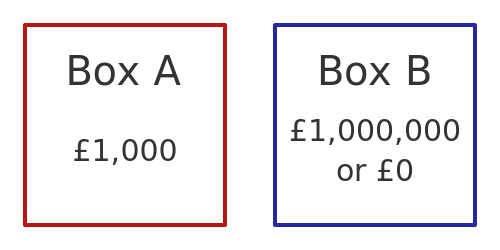
In Newcomb's paradox, there are two boxes:
- Box A is open, and contains £1,000.
- Box B is closed and might either contain nothing or £1,000,000. You have no way of knowing until you make your choice.
You have two choices:
- You can choose to take both boxes. That is, box A (which contains £1,000) and box B (with unknown content).
- You can choose to take only box B, with unknown content.
Now this might seem very easy. In both cases, you get whatever is in box B, but in the first case, you also get box A as well.
But wait, there is one extra factor which might make you change your mind (or it might not). The content of box B is not random. In fact, a super-intelligent AI system has predicted what choice you will make, and decided the content of box B using the following rule:
- If the computer predicts that you will take both boxes, then it will have left box B empty.
- If the computer predicts that you will only take box B, then it will have filled box B with a million pounds.
The computer has already made its prediction, so box B either contains a million pounds or not, depending on what it predicted. But quite a few people have played the game already, and the computer guessed correctly in every case.
There are two main views of this paradox. Both views have plenty of supporters, but many people on both sides find it impossible to understand why anyone supports the opposing view.
The two-boxer argument
Some people look at the problem in this way. Before you have even decided what to do, box A already has £1,000 in it. Box B already has either £1,000,000 or nothing. That has already been fixed and cannot change.
In that case, it is always better to take both boxes. The table below shows the different possibilities.
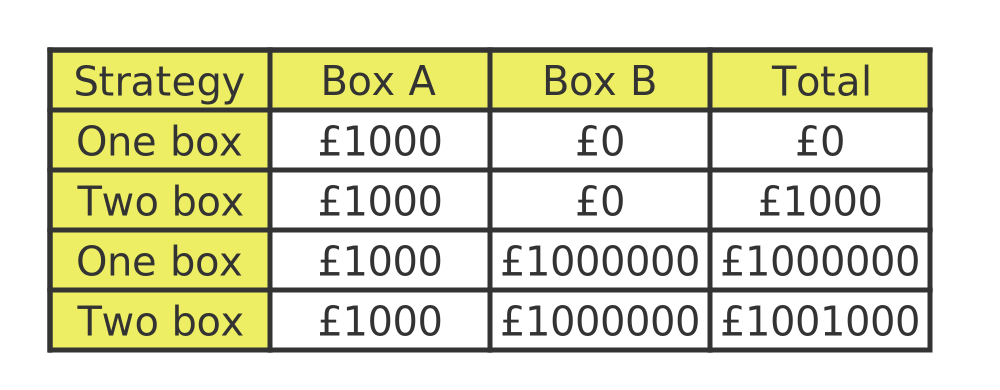
The first two entries show the situation when box B happens to be empty. In that case, the one-box strategy (ie, taking just box B) would give a total return of zero, but the two-box strategy (ie taking both boxes) would give a total return of £1,000.
The last two entries show the situation when box B contains £1,000,000. This time, the one-box strategy would give a total of £1,000,000, but the two-box strategy would give slightly more, £1,001,000.
This means that the two-box strategy will always give a higher return than the one-box strategy.
The one boxer argument
The one boxer argument is very simple. Looking at all the past results, people who chose one box always walked away with £1,000,000. This is because the computer predicted that they would choose one box, and so it put the million in box B.
Also, people who took two boxes always walked away with just £1,000. That is because the computer predicted that they would choose two boxes, and so left box B empty.
Based on that, it is obviously better to be a one boxer.
The problem with the one boxer argument
The problem with the one-boxer argument is that the contents of box B were already decided before you entered the room to make your choice. The box already either contains a million or not, depending on the computer's prediction.
If you are naturally a two-boxer, the computer knows that, so box B will be empty. If you make a last-minute decision, totally against your nature, to only take box B, then you will be a one-boxer. But box B will still be empty, because the computer predicted you would be a two-boxer. So you would lose everything, even the second prize of £1,000.
Unless, of course, the computer predicted that you would change your mind at the last minute, and therefore put the million pounds in the box.
For this reason, some people say that this is an ill-posed question. We have some mysterious computer with some mysterious method of guessing what you are going to decide. But we are given no clue as to how that works. The computer cannot see into the future, so there must be some limits to its predictive powers. But we are being asked to reason about those powers without being told how they work.
A further thought experiment
Suppose you adopted the following strategy. Rather than deciding which option to take, you toss a fair coin. If it is heads, you take one box. If it is tails, you take two.
It might be reasonable to assume that the computer is smart enough to predict that you would use a coin to make your choice. But it can't predict what the outcome of the coin toss will be, that is truly random. So it must decide whether to put the million pounds in box B before it can possibly know what you will do.
We are now in uncharted territory. What will the computer do if it can't predict what you will do? Who knows, we have only been told that the computer has some mysterious method of predicting what you will do. We have absolutely no idea what it might do if it knows that it can't make a reliable prediction. Does it have special rules or some built-in priorities? This is one reason why we might say the question is ill-posed.
Changing the amounts - Pascal's Wager
This paradox has an interesting parallel with Pascal's Wager. The mathematician Blaise Pascal suggested that living your life as if God existed was the only rational choice. His reasoning was that:
- If God exists, then living your life according to his rules means that you will spend the rest of eternity in paradise.
- If God does not exist, then you will have lost very little. You will simply have lived your life following a few rules that you didn't really need to follow.
Pascal argued that you should live your life as if God exists because the benefits if it turns out to be true massively outweigh the loss if it turns out to be false, so the logical choice is to behave as if God exists.
The same might be true of the one boxer argument. £1,000 is quite a lot of money. It is roughly equivalent to one or two weeks' salary for many people. But £1,000,000 is a life-changing sum. Some people might be willing to risk £1,000 to win £1,000,000, without thinking too much about what the odds are.
The one-boxer position appears to be based on the assumption that the computer has extraordinary powers of prediction. But in reality, the computer might just be guessing one single aspect of your personality - your attitude to risk.
Suppose, for example, box A contained £500,000 and box B contained £1,000,000. The logical basis of the paradox wouldn't change. But how many one-boxers would there be in that situation? Who would risk the certainty of getting half a million for the chance of getting a million?
Although, of course, the computer would know that, and would adjust its predictions accordingly.
Summary
My personal opinion is that this is not a well-posed problem. We are presented with a computer with seemingly magical powers, and we need to reason about how it would behave. And since there are situations where the computer cannot predict what you will do (for example, if you had chosen to toss a coin), that doesn't seem to be a reasonable question.
What do you think?
Related articles
Join the GraphicMaths Newsletter
Sign up using this form to receive an email when new content is added to the graphpicmaths or pythoninformer websites:
Popular tags
adder adjacency matrix alu and gate angle answers area argand diagram binary maths cardioid cartesian equation chain rule chord circle cofactor combinations complex modulus complex numbers complex polygon complex power complex root cosh cosine cosine rule countable cpu cube decagon demorgans law derivative determinant diagonal directrix dodecagon e eigenvalue eigenvector ellipse equilateral triangle erf function euclid euler eulers formula eulers identity exercises exponent exponential exterior angle first principles flip-flop focus gabriels horn galileo gamma function gaussian distribution gradient graph hendecagon heptagon heron hexagon hilbert horizontal hyperbola hyperbolic function hyperbolic functions infinity integration integration by parts integration by substitution interior angle inverse function inverse hyperbolic function inverse matrix irrational irrational number irregular polygon isomorphic graph isosceles trapezium isosceles triangle kite koch curve l system lhopitals rule limit line integral locus logarithm maclaurin series major axis matrix matrix algebra mean minor axis n choose r nand gate net newton raphson method nonagon nor gate normal normal distribution not gate octagon or gate parabola parallelogram parametric equation pentagon perimeter permutation matrix permutations pi pi function polar coordinates polynomial power probability probability distribution product rule proof pythagoras proof quadrilateral questions quotient rule radians radius rectangle regular polygon rhombus root sech segment set set-reset flip-flop simpsons rule sine sine rule sinh slope sloping lines solving equations solving triangles square square root squeeze theorem standard curves standard deviation star polygon statistics straight line graphs surface of revolution symmetry tangent tanh transformation transformations translation trapezium triangle turtle graphics uncountable variance vertical volume volume of revolution xnor gate xor gate