Infinite mermaid paradox
Categories: recreational maths paradox
Level:
The infinite mermaid paradox is an infinity paradox with an extremely counterintuitive result.
The setup
The paradox concerns a wealthy man and a mermaid who lives in a lake. The wealthy man decides to give the mermaid some gold coins, but on a very specific schedule.
At one minute to noon, the wealthy man throws two gold coins into the lake. We will refer to them as coins 1 and 2. The coins are all identical, they don't have numbers written on them, the numbers just represent the order in which they were given.
The mermaid immediately throws back coin 1, but keeps coin 2. So she now has 1 gold coin:

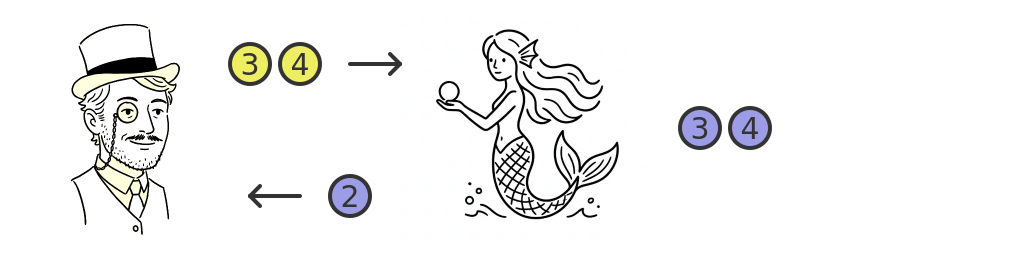
At half a minute to noon, the man throws another two gold coins into the lake. We will refer to them as coins 3 and 4. The mermaid immediately throws back the oldest coin, coin 2, but keeps the others. So she now has 2 gold coins:
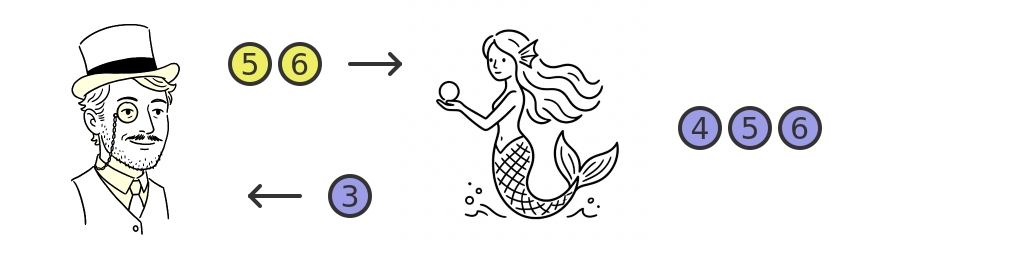
At a quarter of a minute to noon, the man throws another two gold coins, 5 and 6, into the lake. The mermaid throws back the oldest coin, 3, and keeps the others. So she now has 3 gold coins:
At an eighth of a minute to noon, the man throws another two gold coins, 7 and 8, into the lake. The mermaid throws back coin 4, but keeps the others. So she now has 4 gold coins:
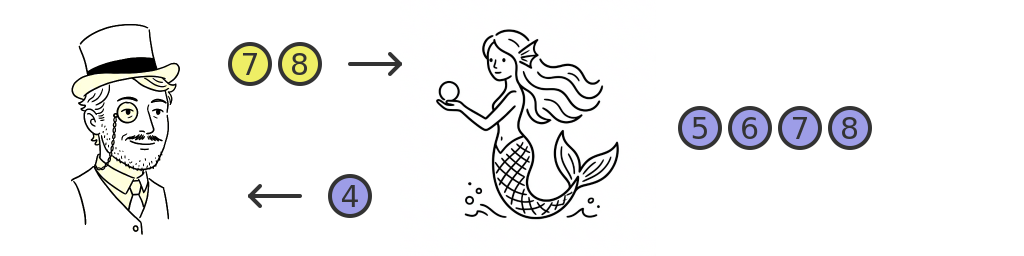
This goes on and on, following the same pattern. The man continues throwing coins into the lake, at 1/16 of a minute before noon, 1/32 of a minute before noon, and so on. On each iteration, the time to noon halves.
One important thing to notice is that, although the time of each iteration gets ever closer to noon, each iteration will always be a finite amount of time before noon. In fact, there will be an infinite number of iterations, but they will all happen before noon. At noon, the wealthy man stops giving coins to the mermaid.
The question
So here is the question that leads to the paradox. How many coins does the mermaid have at noon, when the wealthy man has stopped giving her gold coins?
One thing that seems pretty clear. The wealthy man will have thrown a lot of coins, and each time he throws two coins, the mermaid keeps one of the coins. By the end, she will have a lot of coins. That seems completely obvious.
More than that, the wealthy man will have thrown infinitely many coins, and the mermaid will have kept half of them. And half of infinity is still infinity.
So, surely, she should have infinitely many coins by noon?
The flaw
Well, not so fast! There is a problem here.
On every transaction, she gives a coin back. And not just any coin, but a specific coin. In the first transaction, she gives back coin 1. In the second transaction, she gives back coin 2. Coin number one thousand will be given back in the one thousandth transaction, and coin number one million will be given back in the one millionth transaction. In general, in the nth transaction, she gives back coin n, and the nth transaction will always take place before noon. That will be true for any value of n,
But every coin has a unique number n, so that means that every coin will be given back at some point before noon.
Therefore, despite being given infinitely many coins before noon, and despite the number of coins she holds getting larger and larger as the time gets closer and closer to noon, she will have no coins at all by noon.
It gets weirder
Here is a slight variant that gives a totally different outcome. The wealthy man still gives her two coins, on the same schedule. And she still gives him a coin back each time.
The only difference is that, instead of giving him the oldest coin, she gives him back one of the coins he just gave her. She will choose the coin with the lowest number.
Let's clarify that with a diagram. At one minute to noon, the wealthy man gives her two coins, 1 and 2, and she gives back coin 1 (exactly as before):

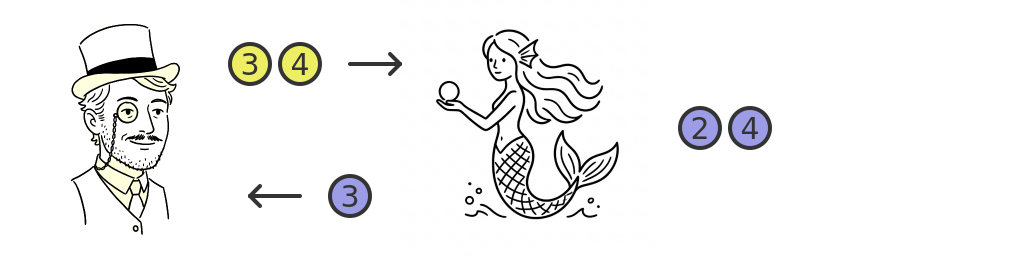
At half a minute to noon, he gives another two gold coins into the lake. Again, she gives a coin back, but remember that this time it will be one of the coins she has just been given. So, this time she returns coin 3 rather than coin 2. So she now has 2 gold coins, but they are coins 2 and 4 rather than 3 and 4:
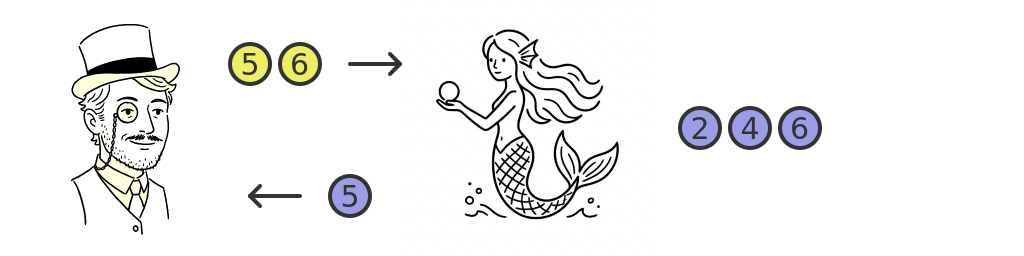
At a quarter of a minute to noon, he gives her coins 5 and 6, and she gives back coin 5:
At an eighth of a minute to noon, he gives her coins 7 and 8, and she gives back coin 7:
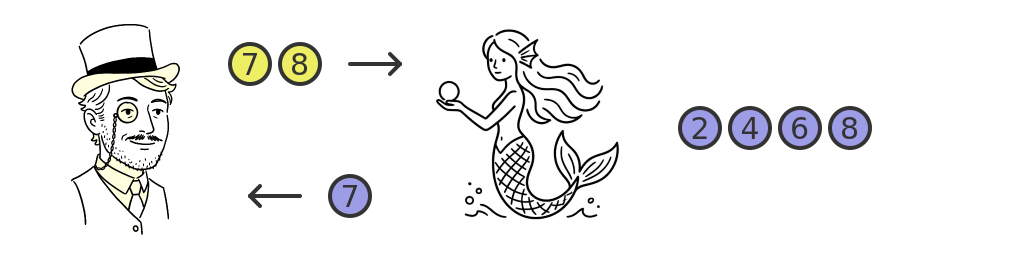
At each stage, she receives 2 coins and gives back 1 coin, exactly like the previous example. After the nth round, she has n coins, exactly as before.
But there is an important difference. She always gives back odd-numbered coins.
So she will never give back coin 2. She will never give back coin 4. Same for every even coin. By noon, the mermaid will have all the even-numbered coins. There are infinitely many even numbers, so she will have infinitely many coins.
What is going on?
If someone was watching this process from a distance, they would see the mermaid accepting two coins and giving one back. each time. They wouldn't necessarily be aware of exactly which physical coin she was giving back each time. Both situations above would look identical.
In fact, the coins are all identical, so it makes absolutely no difference which coins she gives back. The mermaid might decide to number the coins as she gives them back, rather than as she receives them:
- If the mermaid numbers the coins she gives back as 1, 2, 3 ... then by noon, she will have no coins.
- If the mermaid numbers the coins she gives back as 1, 3, 5 ... then by noon she will have infinitely many coins.
That would be true even if she gave back the same physical coins in each case. But how can the number of coins she has at the end depend on how she numbers the coins in her own mind?
Well, for one thing, this situation is entirely hypothetical, for reasons we will see later (for example, nobody really has infinitely many gold coins). When we reason about hypothetical situations, the conclusion we reach can indeed depend on how we think about the problem.
The particular problem here is that the mermaid is receiving an infinite number of gold coins from the wealthy man, but she is also giving back an infinite number of coins. But infinity isn't a number. It might seem like a number, but consider these equations:
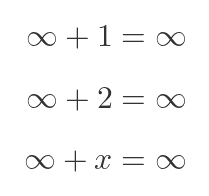
If you add any value x to infinity, you get infinity. Rearranging the last equation gives:
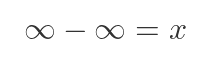
So infinity minus infinity can be anything. When you reason about infinity minus infinity, you can arrive at any number you like.
For example, the mermaid might end up with just one gold coin. Suppose the mermaid keeps coin number 1, but after that, she always returns the oldest coin. This will be similar to the first example, every coin will be given back at some point, except for coin 1 (which she will keep forever). So in that case, infinity minus infinity will be exactly one.
This can't happen in reality
As we noted earlier, this situation obviously cannot occur in reality, for several reasons:
- There is only a certain amount of gold on the planet, so the wealthy man cannot give the mermaid infinitely many coins. At some point, he will run out of coins.
- This whole thing happens in a minute. It takes a finite amount of time to give the gold coins to the mermaid, and each transaction needs to be twice as fast as the previous one. For example, the twentieth transaction must be completed in about 50 microseconds. The 60th transaction must take place in about 1e-18 seconds, which is about how long it takes light to travel the width of an atom. It is impossible to do anything physical, on a macroscopic scale, in that amount of time.
- Even if the wealthy man could somehow bring in gold from other parts of the universe, and even if the experiment allowed a lot more time for the transactions, the accumulation of a (literally) astronomical amount of gold in one place would eventually create a black hole.
If we allow for a finite number of transactions, then the paradox disappears. For example, let's assume that the wealthy man has 1000 gold coins, and we relax the time constraints to make it possible for all the transactions to take place.
After 999 transactions, the mermaid will have 999 coins, and the slightly-less-wealthy man will only have 1 coin left, so the game will end.
That outcome will always be the same, regardless of which coin the mermaid gives back each time. The paradox only arises when there are infinitely many coins.
Related articles
Join the GraphicMaths Newsletter
Sign up using this form to receive an email when new content is added to the graphpicmaths or pythoninformer websites:
Popular tags
adder adjacency matrix alu and gate angle answers area argand diagram binary maths cardioid cartesian equation chain rule chord circle cofactor combinations complex modulus complex numbers complex polygon complex power complex root cosh cosine cosine rule countable cpu cube decagon demorgans law derivative determinant diagonal directrix dodecagon e eigenvalue eigenvector ellipse equilateral triangle erf function euclid euler eulers formula eulers identity exercises exponent exponential exterior angle first principles flip-flop focus gabriels horn galileo gamma function gaussian distribution gradient graph hendecagon heptagon heron hexagon hilbert horizontal hyperbola hyperbolic function hyperbolic functions infinity integration integration by parts integration by substitution interior angle inverse function inverse hyperbolic function inverse matrix irrational irrational number irregular polygon isomorphic graph isosceles trapezium isosceles triangle kite koch curve l system lhopitals rule limit line integral locus logarithm maclaurin series major axis matrix matrix algebra mean minor axis n choose r nand gate net newton raphson method nonagon nor gate normal normal distribution not gate octagon or gate parabola parallelogram parametric equation pentagon perimeter permutation matrix permutations pi pi function polar coordinates polynomial power probability probability distribution product rule proof pythagoras proof quadrilateral questions quotient rule radians radius rectangle regular polygon rhombus root sech segment set set-reset flip-flop simpsons rule sine sine rule sinh slope sloping lines solving equations solving triangles square square root squeeze theorem standard curves standard deviation star polygon statistics straight line graphs surface of revolution symmetry tangent tanh transformation transformations translation trapezium triangle turtle graphics uncountable variance vertical volume volume of revolution xnor gate xor gate