Hexagons - 6-sided polygon - angles, symmetry and properties
Categories: gcse geometry polygon
Level:
A hexagon is a flat shape with 6 straight sides.
Regular and irregular hexagons
A regular hexagon is a 6-sided shape where every side is the same length and every corner has the same angle. All regular hexagons have the same shape, like this:

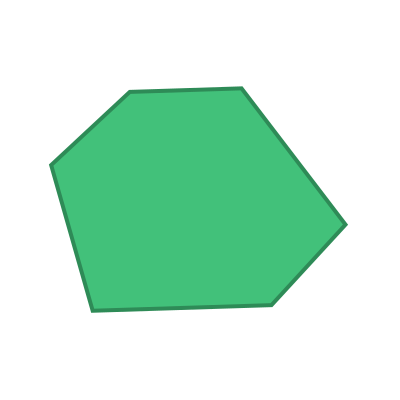
An irregular hexagon is a 6-sided shape where not every side and angle is equal. There are many different irregular hexagon shapes. Here is an example:
Name
The name hexagon is a combination of the prefix hex (Greek meaning six) and gonia (Greek meaning corner).
The prefix hex is used elsewhere. For example, in computing, hexadecimal numbers use base 16 because hex (6) plus dec (10) equals 16.
Hexagons are sometimes called 6-gons.
Interior angles
The interior angles of a hexagon are shown here:
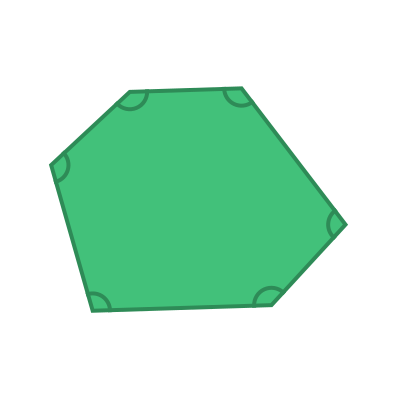
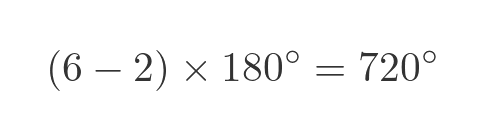
This formula gives the sum of these 6 angles:

Where n is the number of sides. In this case, the number of sides n is 6, so the sum of the interior angles is:
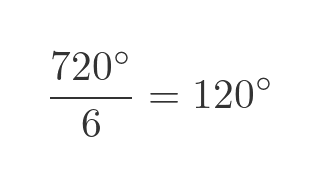
For a regular hexagon, all the interior angles are equal:

This means that the interior angle of a regular hexagon is:
Exterior angles
The exterior angles of a hexagon are shown here:
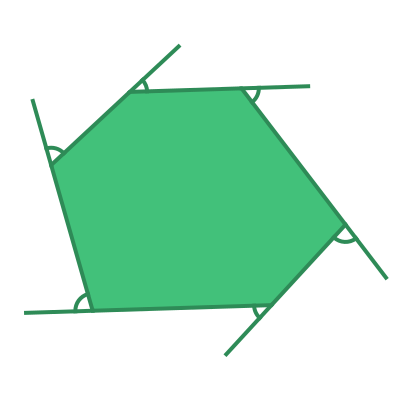
The sum of the exterior angles of any polygon is 360 degrees.
For a regular hexagon, all the exterior angles are equal:
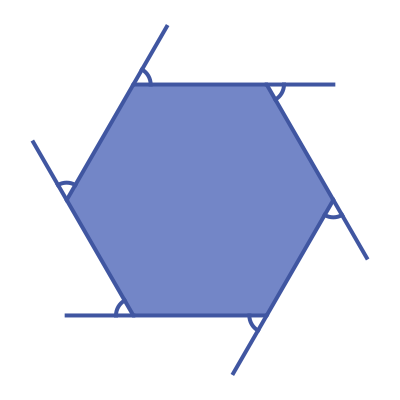
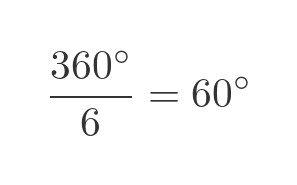
This means that the exterior angle of a regular hexagon is:
Symmetry of regular hexagons
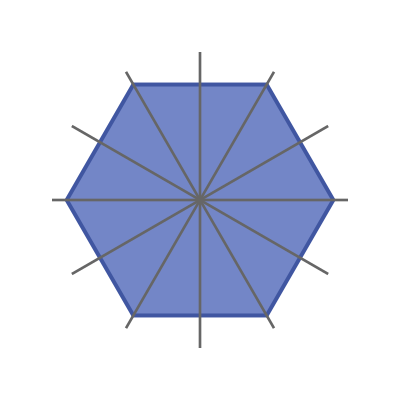
A regular hexagon has 6 lines of symmetry. This means that it can be reflected over each of the 6 grey lines shown here:
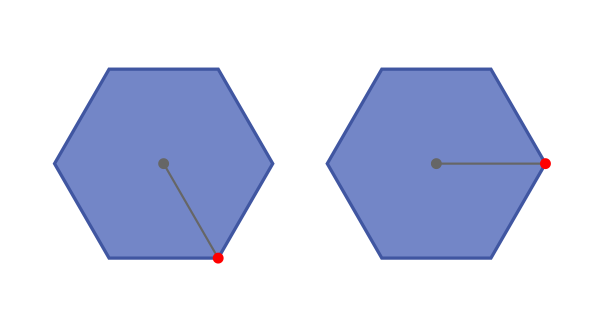
A regular hexagon has rotational symmetry of order 6. This means that if it rotated about its centre by a 6th of a full turn, it will map onto itself:
Diagonals of a hexagon
A hexagon has 9 diagonals, shown here for a regular hexagon:
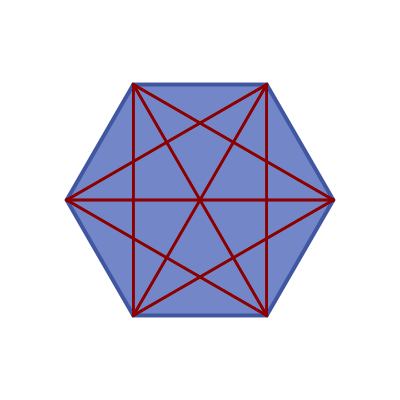
In the case of a regular hexagon, all the diagonals pass through the centre.
Relationship to equilateral triangles
A regular hexagon can be divided into 6 equilateral triangles of equal size, like this:

Each triangle has all sides equal to the hexagon's side length. This also explains why the interior angle is 120° — it is exactly twice the 60° interior angle of an equilateral triangle.
Area of a regular hexagon
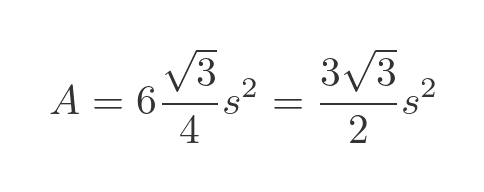
There is a simple formula for the area of a regular hexagon with sides of length s.
We know that the area of an equilateral triangle of side s is:
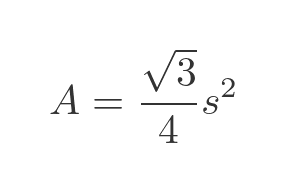
Since a regular hexagon is made up of 6 equilateral triangles, its area is:
Real-life examples
Regular hexagons tessellate (fit together perfectly with no gaps), making them a popular shape for floor and bathroom tiles. The only other regular polygons that tessellate are equilateral triangles and squares.
Other common examples of hexagons in real life include:
- Honeycomb: bees use hexagonal cells because the shape tessellates perfectly and uses the least wax for a given area.
- Hex bolts and nuts: the hexagonal cross-section allows a spanner to grip from multiple angles.
- Pencils: many pencils have a hexagonal cross-section so they don't roll off desks.
- Snowflakes are roughly hexagonal. They always have 6 points because ice crystals form a hexagonal structure.
Related articles
- Regular polygons
- Interior and exterior angles of a polygon
- Triangles
- Quadrilaterals
- Quadrilateral family tree
- Pentagons - polygons with 5 sides
- Heptagons - polygons with 7 sides
- Octagons - polygons with 8 sides
- Nonagons - polygons with 9 sides
- Decagons - polygons with 10 sides
- Hendecagons - polygons with 11 sides
- Dodecagons - polygons with 12 sides
- n-gons - polygons with any number of sides
- Other types of polygon
- Star polygons
Join the GraphicMaths Newsletter
Want article discussions, announcements, and discounts on GraphicMaths books and products? Join the newsletter:
Popular tags
adder adjacency matrix alu and gate angle answers area argand diagram binary maths cantor cardioid cartesian equation chain rule chord circle cofactor combinations complex modulus complex numbers complex polygon complex power complex root cosh cosine cosine rule countable cpu cube decagon demorgans law derivative determinant diagonal differential equation directrix dodecagon e eigenvalue eigenvector einstein ellipse equilateral triangle erf function euclid euler eulers formula eulers identity exercises exponent exponential exterior angle first principles flip-flop focus gabriels horn galileo gamma function gaussian distribution gradient graph hendecagon heptagon heron hexagon hilbert horizontal hyperbola hyperbolic function hyperbolic functions infinity integration integration by parts integration by substitution interior angle inverse function inverse hyperbolic function inverse matrix irrational irrational number irregular polygon isomorphic graph isosceles trapezium isosceles triangle kite koch curve l system lhopitals rule limit line integral locus logarithm maclaurin series major axis matrix matrix algebra mean minor axis n choose r nand gate net newton raphson method nonagon nor gate normal normal distribution not gate octagon or gate parabola parallelogram parametric equation pentagon perimeter permutation matrix permutations pi pi function polar coordinates polynomial power probability probability distribution product rule proof pythagoras proof pythagorean triple quadrilateral questions quotient rule radians radius rectangle regular polygon rhombus root sech segment set set-reset flip-flop simpsons rule sine sine rule sinh slope sloping lines solving equations solving triangles special relativity speed of light square square root squeeze theorem standard curves standard deviation star polygon statistics straight line graphs surface of revolution symmetry tangent tanh transformation transformations translation trapezium triangle turtle graphics uncountable variance veridical paradox vertical volume volume of revolution xnor gate xor gate